
Read the Emanuel County Current Owner Card
The Emanuel County qPublic search is the public starting point for the owner of record. County materials advertise searches by owner, address, parcel, map, transaction, and value. The on-screen labels can shift as the interface is updated. Read the whole parcel card. Do not stop at the first name. The parcel key and situs address must match the land in question before the owner name carries any weight. Confirm both before treating the entry as the answer.
| Owner name | The person, trust, estate, or entity carried on the assessment roll. |
|---|---|
| Mailing address | Where the office sends tax correspondence; it may differ from the property. |
| Situs address | The physical location used to match the current owner to the correct parcel. |
| Map and parcel ID | The tax key joining the card to GIS, bills, deeds, permits, and notices. |
| Transaction data | A clue to the latest transfer, subject to confirmation in the deed index. |
| Value and exemptions | Assessment fields attached to the parcel, not proof of who occupies it. |
The roll identifies the party assessed, not necessarily an occupant. Its mailing address may be a post office box. It may be an out-of-county address, or a contact used by an LLC or lender. The situs is the land itself. The mailing line is just correspondence. Keeping those roles apart prevents confusion. It stops a remote mailing address from being mistaken for a second Emanuel County parcel. The county also provides this qPublic assessor and GIS landing page for the owner and parcel search.
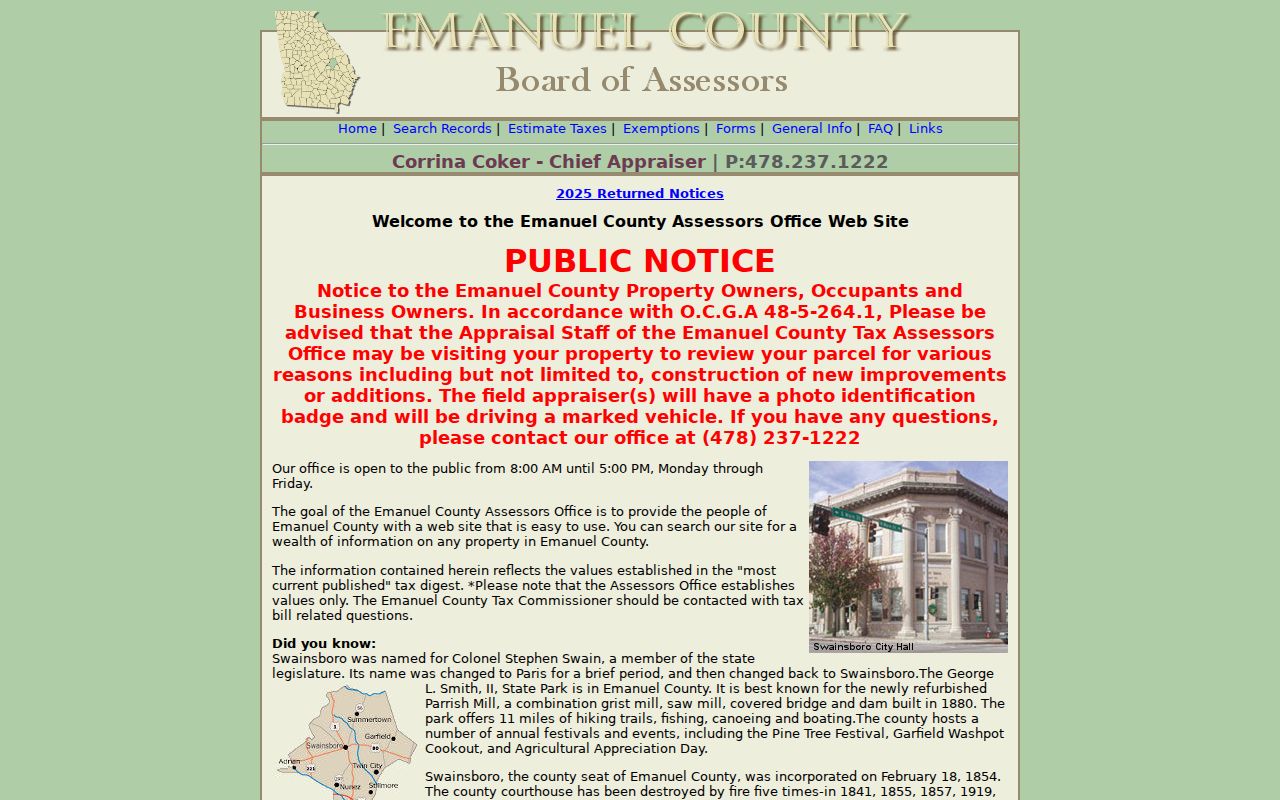
The official county-linked qPublic route remains the dependable path to the parcel card, whatever the live search screen shows on a given day.
Check Emanuel County Situs and Mailing Fields Apart
A current owner search gets stronger when addresses are handled with care. Copy the physical address and the tax-mail address separately. Rural postal labels, city limits, taxing districts, and parcel lines rarely align. Emanuel County geography makes that plain. A Swainsboro mailing label alone does not put land inside the city. An Adrian address can cross county geography. Confirm the parcel ID and the county instead of trusting a familiar city and ZIP. The county building-permit form reinforces this habit. It asks for both the tax map and parcel ID and the project's physical address. Those paired fields help an agency match a property quickly. Preserve letters and zeroes in local identifiers such as S12 005. Silent reformatting can break a match.
Note: No official county source published a measured deed-to-roll update lag, so do not promise a fixed refresh time.
Account for Emanuel County's Annual Roll Cycle
The Board of Tax Assessors maintains the digest. It reviews returns and exemptions, sends assessment notices, and conducts site visits. That assessment cycle is annual. It is not a closing-day feed. After a recent sale, the old assessed owner may still appear. Meanwhile the clerk has already recorded the deed. No published refresh schedule exists. So the date attached to each source matters more than any assumption about system speed.
The practical rule is simple. Use qPublic to identify the parcel and the displayed owner of record. Then compare the most recent deed indexed for that parcel or party. If dates conflict, ask the assessor when the roll last absorbed transfers. Ask the clerk for the newest recorded instrument. The owner shown for taxation and the latest legal grantee can briefly diverge. Neither office is keeping the wrong kind of record.
Recent-sale gap. The assessment roll can trail a new conveyance. The newest recorded deed is the more current ownership evidence, but neither lookup is a title opinion.
Confirm the Current Emanuel County Owner
The deed check stays narrow and present-focused. It verifies the newest grantee rather than walking the full chain of title. The GSCCCA Real Estate Index accepts party, instrument, county, date, and result controls. Its statewide notice displays central coverage beginning in 1990. However, Emanuel County's own earliest online year is not stated. A book-and-page reference can also be run through the GSCCCA book/page search.
- Match the situs and parcel key in qPublic, then copy the displayed owner name exactly.
- Search that party in Emanuel County through GSCCCA and sort the likely conveyances by recording date.
- Read the latest deed's grantee and legal description, checking that it concerns the same land.
- When the grantee is an entity, verify its public filing separately instead of replacing it with an individual's name.
- Owner of record
- The party carried as owner in the public land or assessment record.
- Assessment roll
- The assessor's property list used to prepare the county tax digest.
- Situs address
- The physical location, distinct from the address used for tax mail.
- Recording lag
- The interval in which a deed is recorded but a related roll has not yet changed.
Resolve Emanuel County Entity Owners
An LLC name on the roll or deed is the current owner name. It is not an obstacle to edit away. Search the exact entity in the Georgia Secretary of State business database. Fields cover business name, control number, registered-agent name, and officer name. You can pick starts-with, contains, or exact-match options. The filing can supply a public contact and confirm the entity name was entered correctly. A registered agent is not automatically the owner, occupant, or beneficial owner. A trustee's name describes a legal role. An estate name may point toward probate. Keep each source in its lane. The assessor identifies the assessed party, the deed states the grantee, and the state filing describes the entity. A probate file can explain an estate transfer, but it never replaces the land record.
Note: Search entity punctuation and abbreviations several ways, but compare control numbers before treating similar business names as one owner.
Use Emanuel County's Two In-Person Desks
Don't rely on the screen alone. Assessor duties moved in 2025. The Tax Assessor and Tax Commissioner were consolidated into the Davis-Thompson Building at 223 W Moring Street in Swainsboro. Deeds stayed behind at the Emanuel County Clerk of Superior Court, 125 S Main Street. That split matters most after a recent sale. The assessor's desk can explain how the tax roll reflects the change. The clerk pulls the recorded instrument itself.
Visit the clerk Monday through Friday, 8 AM to 5 PM, or call 478-237-8911. GSCCAA notes that full database access is free at any Georgia Superior Court clerk office. Even so, online images require an account. Counter requests are the county-published route for deed copies too. If a record sits outside routine lookup channels, the Emanuel County Open Records form covers electronic, mail, and pickup delivery.
Watch Future Emanuel County Filings
GSCCCA's Filing Activity Notification System is called FANS. It watches for later filings against a name or address. It works best after the current owner and exact address are confirmed. Think of it as a forward-looking alert. Deed fraud is a common reason to use it. An alert does not certify ownership. It does not stop a filing. It never replaces reading the recorded instrument. Treat a notice as a prompt. Pull the clerk's record next. The system cannot cure a weak match. Common names, spelling differences, and entity variants generate noise or miss filings. Record the parcel ID, exact grantee spelling, and deed reference before starting a watch. That packet makes each alert easier to evaluate.
Use an Emanuel County Owner Record Lawfully
The tax-mail address is the strongest contact clue in an Emanuel County owner record. Use it with care. A different mailing address proves nothing about where a person lives, whether the parcel sits vacant, or whether the listed party occupies it. Redacted address data is not proof of hiding. The parcel, not the person, is the subject. Keep contact factual and tied to the land, whether the matter is a purchase inquiry, a boundary question, an estate, or a deed-fraud check.
Lawful use. Public owner information supports legitimate property research. It must never be used to stalk, harass, intimidate, or harm a person.